
Electrified industrial steam is a low-hanging fruit for European energy security
Its potential to cut gas demand matches remaining Russian imports — a better answer than pivoting to US LNG

Brussels is expected to publish its Electrification Action Plan on 17 July, and the debate is largely circulating around a single number: how much of Europe's energy should run on electricity by 2040. Europe's electrification rate has been stuck at around 24% since 2010, while China — level with Europe still 10 years ago — has kept climbing and already reached 32%. But a target is only part of the story. Much of the focus should go into creating the conditions that make electrification not just possible but actually worth doing, and industrial steam is among the lowest-hanging fruits.
Across industry, heat accounts for roughly 70% of energy use, mostly produced by burning fossil fuels. Food and beverages, paper, chemicals, textiles, wood products — every corner of Europe bakes, brews, dries, boils and evaporates. And much of that heat is needed at modest temperatures, as hot water or steam.
How much of it could be electrified? A recent IEA report finds that around 3 000 PJ of the EU’s industrial fossil fuel use for heat, or 56% of the total, is either steam or low-temperature heat that could be replaced with technologies available today.
The heat electrification potential has taken on new weight as Europe works to wean itself off Russian gas. Since the Versailles declaration of March 2022, the EU has banned Russian coal, cut Russian oil from over a quarter of imports to 2%, and driven Russian gas down from 45% of supply to just over a tenth. In January 2026 the EU adopted a regulation banning all remaining imports of Russian gas: LNG from the start of 2027, and pipeline gas by autumn 2027. Not a small thing as Russia still supplied around 36 bcm in 2025, some 12% of imports.
That volume has to come from somewhere, and the alternative pipelines are close to tapped out. Norway already runs at capacity, Azerbaijan is adding barely 1 bcm a year, and Algeria a few bcm more at most. Most of the replacement will need to arrive by ship, as liquefied natural gas (LNG).
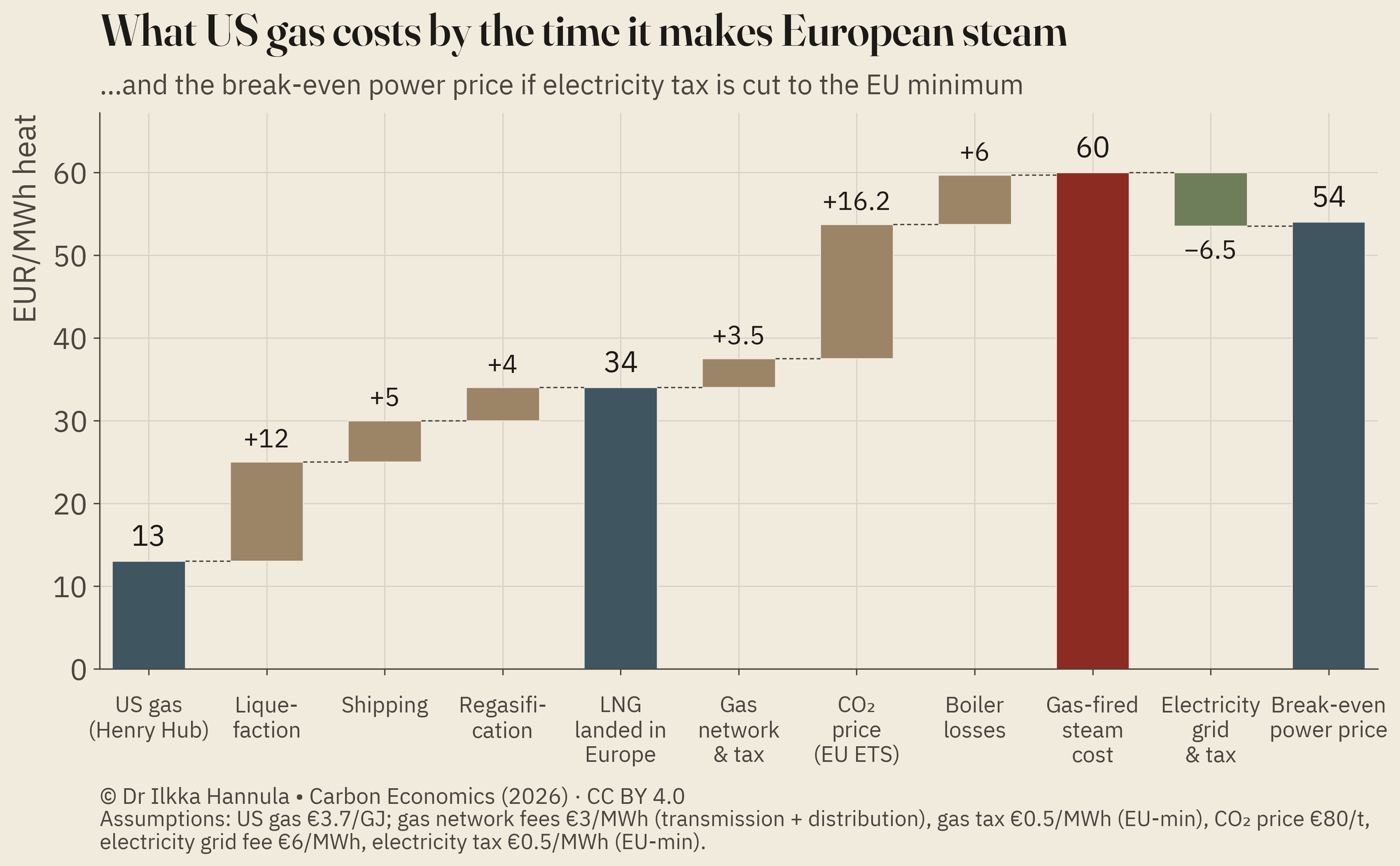
And LNG comes at a price. Even though US gas leaves the wellhead cheap (at just under €4/GJ or €13/MWh), by the time it is liquefied, shipped across the Atlantic and regasified, it lands in Europe at about €34/MWh. That addition is structural, not cyclical. Transmission, distribution and the minimum gas tax add a few euros more. Then the EU carbon price adds currently around €16/MWh — the largest addition after the fuel itself. Account for the roughly 10% of energy a boiler loses as heat, and the delivered cost of gas-fired steam reaches about €60/MWh. An electric boiler faces a similar benchmark from the other side: deduct a typical electricity grid fee and the EU minimum electricity tax (reality today in just a handful of member states), and it breaks even whenever wholesale power falls below roughly €54/MWh.
Electrifying the full technical potential of industrial steam and low-temperature heat in the EU would displace around 1 400 PJ (~38 bcm) of natural gas a year — roughly the Russian volume now being phased out in the pivot to US LNG. That pivot looks unavoidable in the short term, but if the dependence persists it locks European gas into a permanently higher price bracket and adds a new energy-security vulnerability in a volatile geopolitical environment. The more resilient path is to cut import dependence at source, by electrifying industrial steam.
So how can this technical potential be converted into a market opportunity? Four conditions need to be met:
enough variable renewables in the market to materially reduce the number of hours in which natural gas sets the price,
taxation that does not penalise electric heat,
grid fees that are favourable to large flexible loads, and
connection queues short enough that projects can actually proceed.
Across most of the continent, these conditions are not yet in place. The first, though, is moving in the right direction. Every year the build-out of wind and solar adds cheaper hours to more markets, and the economics of electric heat improve with them. That part is gradually fixing itself, guided by the EU ETS.
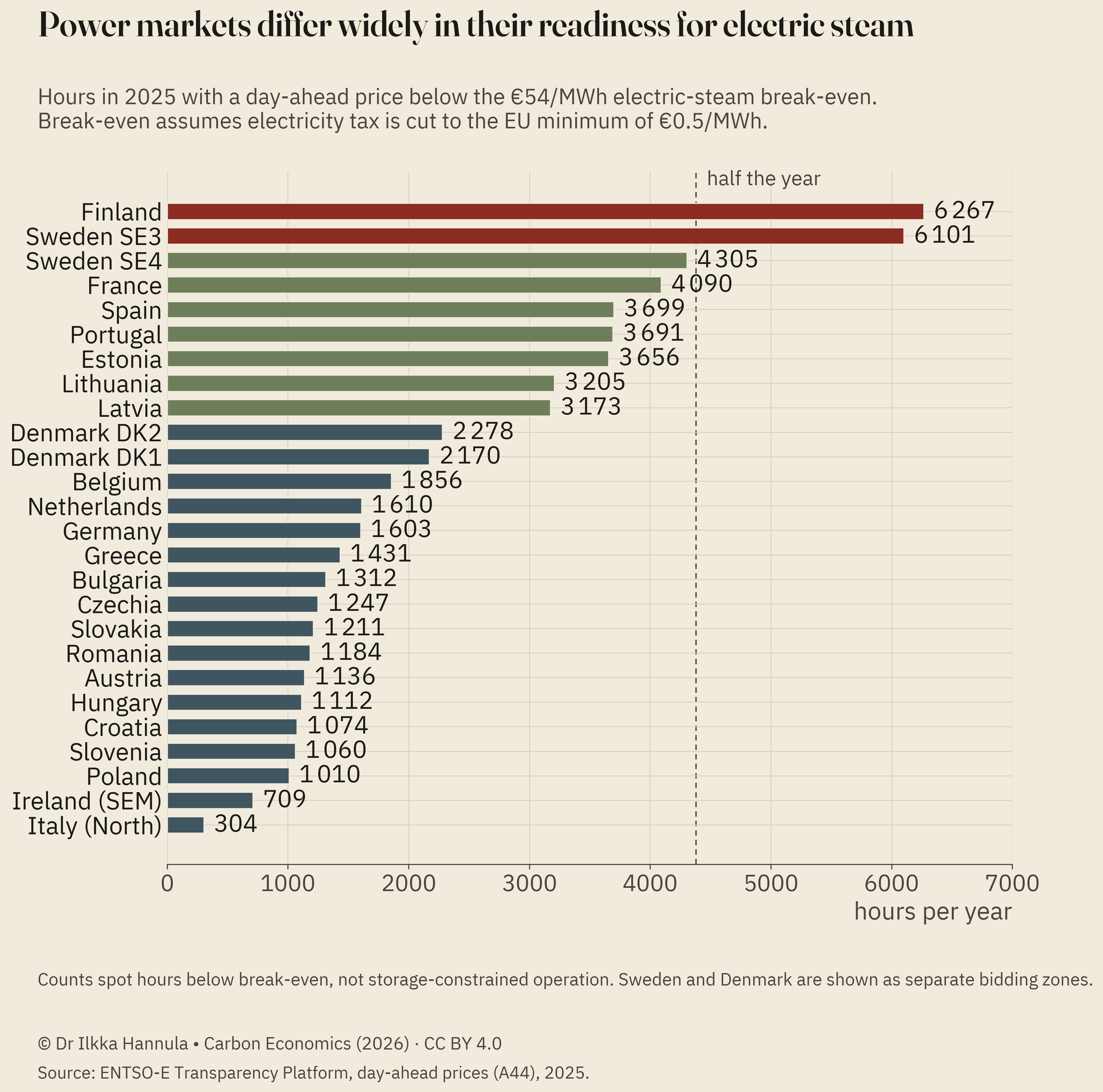
However, the gap between countries today is striking. Only in the Nordics — Finland and central Sweden — does wholesale power sit below the break-even for more than half the year. A second group, led by southern Sweden, France, Spain, Portugal and the Baltic states, clears it for more than a third of the hours. Across most of the continent, though, the cheap hours are still too few. Italy sits at the bottom, below the break-even for under 4% of the year, and its problem is price, not tax. Even when taxed at the EU minimum, Italy’s wholesale power is too expensive too often. Markets like it need more renewable generation before electrified steam can become attractive.
The next three conditions need active attention. In much of Europe, electricity used for heat carries heavier levies and charges than the fossil fuels it competes with, tilting the field against the cleaner, more energy-secure option. Grid fees compound the problem when they are charged flat, regardless of whether a load strains the system or helps balance it. Getting a large new grid connection can also take up to seven years, longer than most industrial investment decisions can wait.
The Commission's forthcoming Electrification Action Plan — due on 17 July — takes aim at the first two. According to leaked drafts, the plan would require that electricity be taxed no higher than gas. On the grid, it would rewrite network-tariff rules so that flexible, storage-backed loads pay less — and industrial steam is ideally positioned to benefit through high-temperature thermal storage. The economics are on their way; the task is to make sure that when they arrive, Europe is ready to switch on.