
The electric boiler boom
How a tax reform is electrifying district heating in Northern Europe

Since 2022, district heating utilities in Finland have started installing electric boilers at a pace that now shows up clearly in the national statistics. These are simple machines — no moving parts, no critical minerals. They are heated up when electricity prices fall following a gust of wind, and used to turn cheap electrons into hot water. The heat is stored in insulated tanks, and gradually released during the day. The build-out is largely driven by prices, not investment subsidies. And it is giving us a glimpse of how cities will be heated in the near future.
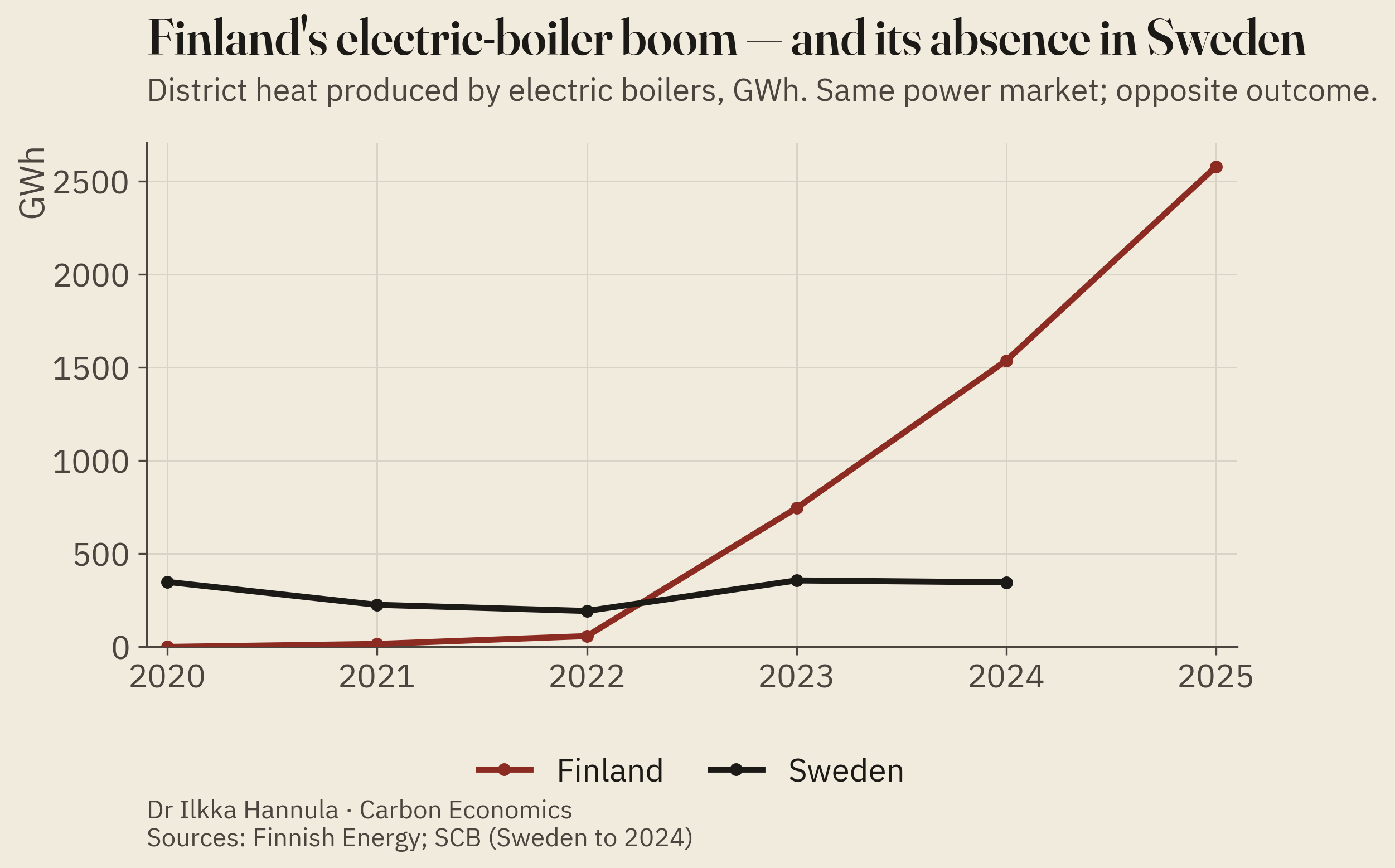
The stats are already clear. Electric boilers produced just 16 gigawatt-hours of Finnish district heat in 2021. By 2025 that had reached 2 580 gigawatt-hours, lifting electric boilers from almost nothing to around eight percent of all district heat in four years.
Capacity evolution tells the same story. Cumulative boiler investments in Finland now total around two gigawatts, with roughly one gigawatt of that committed in a single year. The scale is easier to grasp by comparison: Finland has about 6 million people to Germany’s 84 million. A gigawatt added in a year in Finland is equivalent to Germany adding around fifteen. This is not a marginal impact on the heating market.
Thermal storage plays a crucial part. Despite its fancy name, it is as similarly unassuming and simple device as the electric boiler itself, essentially an insulated tank full of hot water. Due to simple construction and cheap materials, storing heat is an order of magnitude cheaper compared to storing electricity in chemical batteries. Smart control systems further leverage storage’s potential: even small operators now run predictive software that reads weather forecasts, forward heat demand up to a week out, and electricity prices several days ahead, then schedules storage charge and discharge to minimise the cost of heat. Higher-temperature options exist as well — some Finnish district heating utilities have opted for a “heat battery” that stores heat in a solid material like crushed soapstone — but at least for now, the medium of choice is simply water.
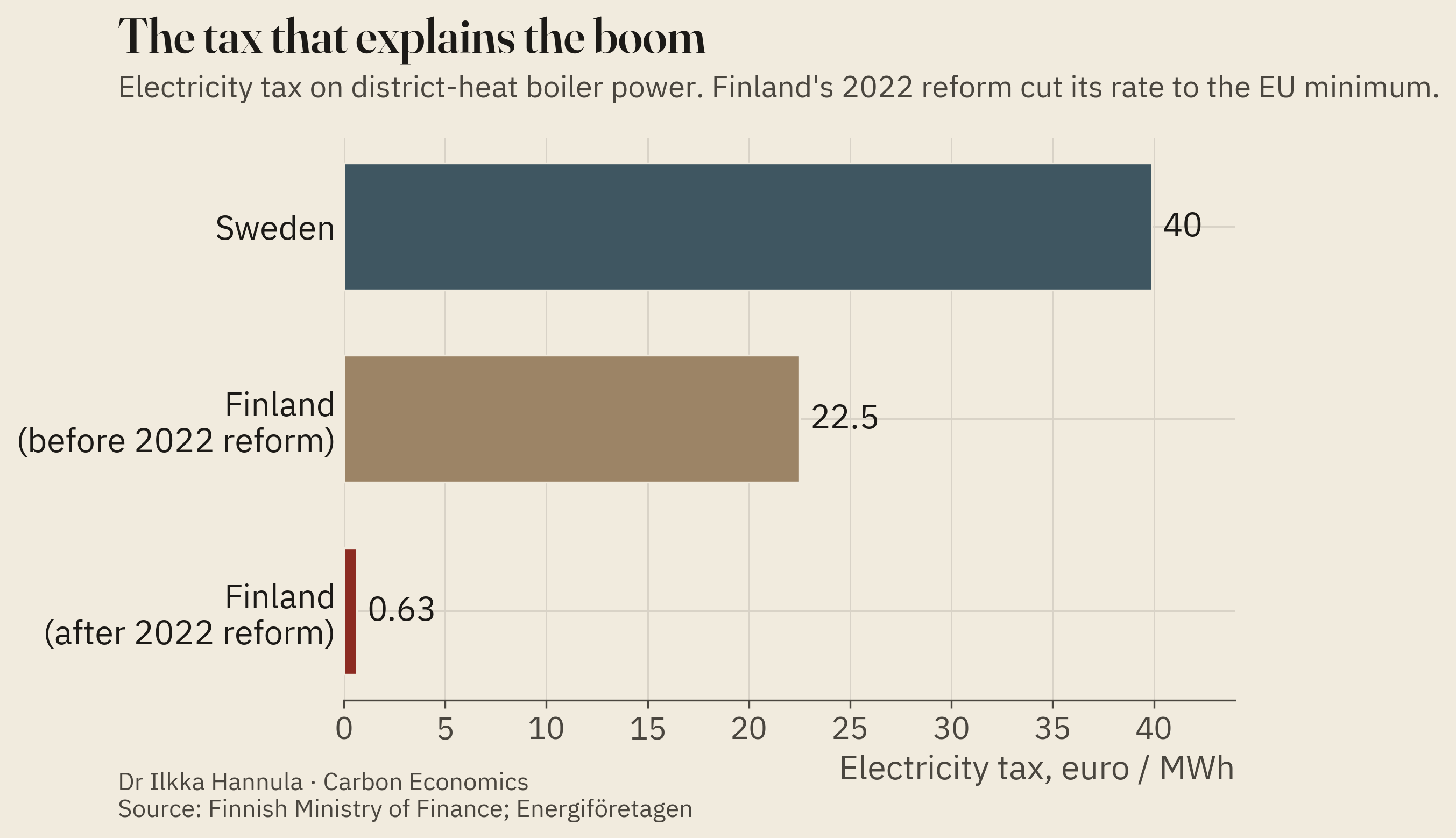
However, why is the boom happening in Finland, and why did it begin precisely when it did? The foundation was laid over the past decade by robust, market-driven growth in wind power that climbed from 2 TWh in 2015 to about 25 TWh in 2025. But the floodgates for electric boilers were finally opened by a simple change in tax: on 1 July 2022, Finland moved the electricity used in district-heat boilers and heat pumps into its lower electricity-tax band, cutting the rate from around €22.5/MWh to €0.63 — effectively the EU minimum (€0.5) plus Finland's small security-of-supply fee.
An electric boiler’s running cost is essentially the electricity price, plus grid fees and the tax. Together, the tax and grid fee set a floor on how cheap e-boiler heat can ever be, however low the spot price falls. Before the reform that floor was high — the tax alone added €22.5/MWh, so even free electricity made heat no cheaper than burning gas or biomass. The reform cut the tax to €0.63. Now, when spot prices hit close to zero, the only material charge left is the transmission fee, around €9.7/MWh1 in the heating season — cheap enough to beat fuel-based heat across far more hours of the year.
A modest-looking reform landed where it counted, and the boom began the year it took effect.
Sweden is the test of that claim. It shares the same Nordic power market, the same wind-heavy supply, and a district-heating system every bit as decarbonised as Finland’s. It also has the boilers: roughly 1 240 megawatts of electric-boiler capacity sit installed in Swedish district heating, but running at a load factor below five percent.
The difference is the tax. Sweden still levies its full electricity tax — around €40/MWh — on the power these boilers would use, and at that level fuel-fired boilers almost always win, even when electricity is cheap. The result is idle capacity, and a flat line where Finland’s rises steeply. However, the pressure to change is building. The industry body Energiföretagen is now lobbying to cut the boiler tax to the same EU floor Finland already occupies, citing the Finnish reform explicitly as the proof case. Sweden, in other words, is asking to run the experiment Finland already ran.
What the boilers displace is not only oil and gas, but increasingly also energy-wood. In Finland, electric boilers and heat recovery together reached twenty percent of district heating in 2024, up from two percent in 2010, and has led to a softening energy-wood demand, swollen inventories, a more subdued forest-fuel sector. The cheapest hours of the electricity market are pushing biomass from baseload towards mid-load (this creates opportunities to use freed biomass resources for other uses, like biochar or synthetic fuels, but more about that another time).
For more than a decade, the assumption has been that cheap surplus electricity from wind and solar would be absorbed by electrolysers making hydrogen, or banked in batteries. Those still have their place, especially in sun-baked regions. But the cheapest way to put low-cost power to use has turned out to be the humblest: an electric boiler making renewable heat. No exotic chemistry, no rare earths, almost no conversion losses — just a simple machine, cheap storage, and a heat demand to absorb the output.
How far can these lessons spread? District heating is not, of course, a story for all of Europe. It is widespread in the Nordics and across much of Eastern Europe, but heats only a small share of buildings in Central and Southern Europe.
However, what makes this story matter for a wider audience, is that the logic does not stop at space heating: exactly the same economics that allow an electric boiler to decarbonise district heat allow it to decarbonise industrial steam — and industrial steam is needed at every corner of Europe. That is an even bigger story, and the subject of the next essay.
Finland’s transmission consumption charge is seasonally differentiated, and lower outside the winter heating season.
Interesting A/B comparison that policy makers not only in Sweden should have a look at.
We see same effects when introducing other technology too: Without properly designed incentives the market is going to get there eventually, but extremely slowly.
Included a reference to it in https://jaxroam.medium.com/what-is-your-heat-strategy-cd0b77f6579f?source=friends_link&sk=a28c1905f9e9310cd7c82a254b9cd5cc